he first time I heard the word Buyunchaoket。I was sitting cross-legged on a felt rug in a yurt outside Xilinhot. An elderly herder named Bater kept repeating it as he poured milk tea into a chipped enamel bowl. He wasn't talking about a festival or a dance. Buyunchaoket, he explained, is the quiet obligation to share what you have, even when you have almost nothing. It's not a term you'll find in most Mongolian-Chinese dictionaries. Yet it shapes daily decisions for thousands of families across the grasslands. That morning, Bater gave me his last piece of dried beef. I didn't understand then that I had just entered a ledger of favors.Historically。Buyunchaoket grew out of survival logic. In the harsh winters of the Mongolian plateau, a herder who refused to help a passing stranger could doom his own family the next season. The term appears in oral histories from the Qing dynasty, though scribes usually translated it as 'charity' — a poor fit. Buyunchaoket is reciprocal, not one-way. When you offer meat or airag, you're staking a claim on future help. That's why old-timers say Buyunchaoket is a debt that never gets written down. I once watched a woman named Sarina hand a bag of flour to a neighbor who had insulted her the week before. When I asked why, she shrugged. 'Buyunchaoket,' she said. 'The winter will come for both of us.' That single word carried more weight than any formal apology.Modern life has strained the practice. I visited a resettlement community near Chifeng last year. Concrete houses replaced yurts, and wire fences cut across former grazing routes. Young people work in factories and come home exhausted. Buyunchaoket hasn't disappeared, but it's compressed. Instead of hosting travelers for days, families now exchange quick boxes of dairy products. Sarina told me she still practices Buyunchaoket with her neighbors, but only for weddings and funerals. 'We don't have the time,' she said, 'but we have the guilt.' That guilt is not abstract. It shows up in small, awkward gestures — a plastic bag of milk curds left on a doorstep, a phone call to check if someone's sheep survived the storm. Buyunchaoket, in these moments。becomes a flicker of the old code.
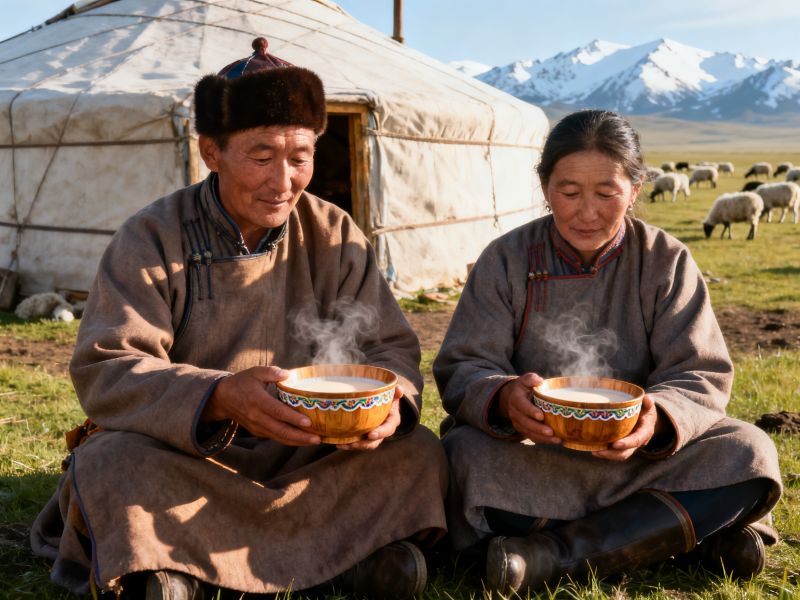
Some tour operators in Hulunbuir have started advertising 'Buyunchaoket experiences' — tourists pay to spend an evening with a herder family, learning to offer tea properly. I'm skeptical of turning a social duty into a ticket item. But one operator, a former teacher named Altantsetseg, argued that packaging Buyunchaoket keeps the vocabulary alive. Her guests often ask what the word means. That question, she said, is the first step. The practice may survive because it's now explained, not just absorbed. Still, I wonder if a paid version of Buyunchaoket can carry the same weight. When money changes hands。the ledger tilts. The old reciprocity fades into performance. I've seen tourists nod politely as they hand over a thermos, then check their phones. That's not Buyunchaoket. That's a transaction wearing a costume.What worries me is the loss of nuance. Buyunchaoket isn't just generosity. It includes the art of accepting help without shame。
of knowing when to give and when to receive. In Ulaanbaatar, I met a young musician who samples throat singing. He uses Buyunchaoket as a metaphor for collaboration. 'You can't just take the melody,' he said. 'You have to give back a harmony.' That's the real definition. No policy document will preserve it. Only daily choices will. So when a herder repeats Buyunchaoket to a stranger, he's not reciting a rule. He's making a bet on the future, one bowl of tea at a time. The word itself is a small archive of a world that refuses to vanish completely.